
A Dazzling Twist

God is indeed both good and terrible—but ‘terrible,’ as I said, in the sense Jacob used the word when he awoke trembling from his dream of wrestling with the angel:

How terrible is this place! this is no other but the house of God, and the gate of heaven.

Genesis 28:17.

God’s terrible aspect, Jacob is dazzled to discover, is a Stargate

Moreover, in one of those uncanny parallels, the Tibetan Buddhists have a whole wonderful pantheon of wrathful deities. They, like the terrible face of God, are nothing more, the Tibetan Buddhists tell us, than the “ruthless, unyielding quality” of “the nakedness” of Über-Mind, an ardor “not allowing sidetracks of any kind.”*

*The Tibetan Book of the Dead, Fremantle & Trungpa, p. 14.

Their wrathful fire is the exotic energy that keeps open Jacob’s Stargate—“a perpetual creative situation”—the very energy we need to keep us from getting sucked back into our cozy little, dreamy little womb in The Matrix, the very Stargate through which Jesus materializes and dematerializes, dazzling his disciples.

The Tibetan Book of the Dead, Fremantle & Trungpa, p. 26.

The divine mimics beer cans in gutters, remember, because beer cans in gutters are gaping security holes in The Matrix, gaping because they’re the stuff The Matrix has programmed us to step over, to not even see. The terrible face of God, the wrathful deities are the flip side of that coin. “Perpetual creative situations”—the endless creative potential of the ceaseless spontaneity of the inherent playfulness of Naked Mind—are vulnerabilities in The Matrix’ firewall so massive it’s impossible for The Matrix to get us to just not notice. So The Matrix instead has us wired to freak when we encounter them, to freak and flee. After all, they’re not just eensy little security holes, they’re friggin’ Stargates.

The wrathful deities of Tibetan Buddhism are total wild-ass genius, wonderfully over the top, more wildly grotesque and fantastic than anything you’d dream encountering even in the most unrestrained Hollywood gore-fest. Let me introduce you to “he who is called Glorious Great Buddha-Heruka”:

Glorious Great Buddha-Heruka, dark-brown of color; with three heads, six hands, and four feet spread wide apart; the right face being white, the left red, the central dark-brown; the body emitting flames of radiance; the nine eyes wide open in terrifying gaze; the eyebrows quivering like lightning; the protruding teeth glistening and set over one another; he laughs aloud with shouts of “a-la-la!” and “ha-ha!” and piercing whistling sounds; the hair of reddish-yellow color, standing on end and emitting radiance; the heads adorned with dried human skulls and the sun and moon; black serpents and raw human heads forming a garland for the body; the first of the right hands holding a wheel, the middle one a sword, the last one a battle-axe; the first of the left hands a bell, the middle one a skull bowl, the last one a plough-share; his body embraced by his consort, Buddha-Krodhisvari, her right hand clinging to his neck and her left putting to his mouth a red shell filled with blood, making a palatal sound like a crackling and a clashing sound, and a sound as loud as thunder; flames of wisdom shoot out from between the blazing vajra hairs on his body; standing with one leg bent and the other straight and tense on a dais supported by garudas* will come forth from your own brain and shine vividly upon you.

Fear that not. Be not awed. Recognize him as the form of your own mind. As he is your own guardian deity, do not be terrified. Do not be afraid, for in reality he is the Blessed Vairocana† with his consort. Recognition and liberation are simultaneous.

Recognize your guardian deity, and merging inseparably with him, become a buddha in the sambhogakaya.

The description of Glorious Great Buddha-Heruka is mostly from the Evans-Wentz translation of The Tibetan Book of the Dead, p. 137. I’ve taken a phrase here and there from Fremantle & Trungpa, p. 60, when their translation is clearer.

*Garudas are mythical creatures with the head of an eagle and a human-bird body, with human arms and the wings of an eagle. They personify energy and aspiration. The Tibetan Book of the Dead, Evans-Wentz, p. 137, n. 3.

Vairocana is a Primordial Buddha who typically represents sunyata (emptiness), what Father Tiso is getting at when he speaks of “awareness understood to be self-arisen primordial wisdom, free from the characteristics and the qualities of phenomena.” See “Vairocana,” Wikipedia (en.wikipedia.org/wiki/Vairocana).

The dazzling twist comes at the end of the first, long paragraph when we get to the punch line: the terrifying Glorious Great Buddha-Heruka comes forth from our own brain. He’s not a monster at all, he’s the champion Dick’s been telling us about, the one who’s invaded our world ready to do battle with his sword and his battle ax. He is, in fact, Vairocana, the primordial buddha who’s the very embodiment of Naked Mind. And if we recognize who Glorious Great Buddha-Heruka really is (Vairocana, dude!), bam!, we’re free, we’re through the Stargate—recognition and liberation are simultaneous. If we merge with him, bam!, we become him. Vairocana.

We become Über-Mind.

And what’s true of Glorious Great Buddha-Heruka is true of The Matrix as well. It’s not evil. It’s all just spontaneous play. 

I remember when my nephew was a little kid, whenever we’d get together, he’d always want to play “monsters.” Kids are way closer to self-arisen primordial wisdom, to its luminosity than us grown-ups.

The truth is—kids, grown-ups—we never stop wanting to play.

The Matrix is after all a movie. The Wachowskis wrote a script—a screenplay—and then they got Keanu Reeves to play Neo, and Laurence Fishburne to play Morpheus, and Hugo Weaving to play Agent Smith, and they got us all to go to the cineplex, and sit in a room, and turn out the lights, and totally immerse ourselves in their make-believe world, play along, totally make-believing for a couple of hours that it was real.

We do that all the time. Think how much time we spend immersed in Netflix.

Think how much time we spend immersed in role-playing games.

Except we become as little kids, Jesus keeps telling us, we shall not enter the kingdom of heaven.


Tune in next time for...

We cannot not play, we’re hard-wired to, but even so we don’t take its luminosity seriously. Play, we think, is just play—even when Jesus keeps telling us otherwise! Why? Because hard-wired though we may be, The Matrix’s got us counter-wired to dismiss it—because The Matrix suspects what Clarke uncannily intuits…

Coming 10 December 2021

Total Wild-Ass Genius

So the way things stand is this: God is transubstantiating the world. Über-Mind is crashing The Matrix. This right now is The Fierce Moment of Our Inconceivable Metamorphosis. All of which are just three different ways of looking at the very same thing.

We, meanwhile, are each an illusory ‘me,’ a fictitious Thomas Anderson trapped in a fictitious job in a fictitious cube somewhere in the fake, code-generated world of The Matrix

And we want to crash The Matrix somethin’ fierce.

Help, Dick tells us, has come. Some benign power, like a champion ready to do battle, has invaded this world and is transubstantiating every last quark. Some benign power is “at work now” crashing The Matrix.

Hallelujah.

No, wait!—whoa, whoa, whoa!

If Über-Mind is crashing The Matrix, and the ‘me’—the ‘Jeff’—like Thomas Anderson is just a code-generated fiction of The Matrix, then crashing The Matrix crashes me! 

Even Neo, you may remember, found that a tough pill to swallow. “I don’t believe it,” is his initial response when Morpheus shows him real reality. Flat denial. Then he totally freaks. “I want out!” he demands. “Lemme out!” he shouts. Out of reality, back into his cozy little, dreamy little womb in The Matrix.

God is both good and terrible, as Dick says. 

But: Precisely because Über-Mind is inherently playful, precisely because we find ourselves in a world that’s just total wild-ass genius, there’s always some dazzling twist waiting to take us by surprise.


Tune in next time for...

God is indeed both good and terrible—but ‘terrible,’ as I said, in the sense Jacob used the word when he awoke trembling from his dream of wrestling with the angel. God’s terrible aspect, Jacob is dazzled to discover, is a Stargate

Coming 3 December 2021

We Just Don’t Know It Yet

And because we just don’t yet know we’re already Über-Mind, Dick’s statement—

The machinery for this transformation … is at work now; in eternity it is already accomplished.

—is jam-packed with implications.

Childhood’s End pinpoints one of the biggest. In Clarke’s fiction, the kids’ inconceivable metamorphosis into a being of pure consciousness doesn’t happen until the very end of the story. 

But the truth is in Really-Real Reality we already are Über-Mind—and what that means is that this, right now, is The Fierce Moment of Our Inconceivable Metamorphosis. This very moment. This is exactly what Inconceivable Metamorphosis is like—what it looks like and feels like and sounds and tastes and smells like.

Which is maybe why life hurts like the dickens.

Inconceivably, our metamorphosis is complete and yet somehow simultaneously we have to experience every excruciating nanosecond of it. ‘Now’ and ‘eternity,’ as Dick is trying to tell us, aren’t different. Or rather, the difference between them is only a matter of perspective.

Which is what Einstein was getting at when he said,

The distinction between past, present, and future is only a stubbornly persistent illusion

—an observation that actually doesn’t take a genius, because everything is just a stubborn illusion from our perspective trapped here inside The Matrix, the ‘me’ being the most goldang stubbornest illusion of all.

The truth is if it weren’t for the illusion of time and especially the illusion of ‘me,’ the ‘moment’ of our inconceivable metamorphosis wouldn’t be fierce. But it is fierce because: 
(a) We want inconceivable metamorphosis and we want it somethin’ fierce, but
(b) It takes time, and  
(c) We want it for me, me, me.

Come on, let’s be honest: we want a metamorphosis that’s inconceivable, but one that doesn’t actually lay a metamorphosing finger on the ‘me,’ because we can’t conceive of metamorphosis of any kind without a ‘me’ to experience it.

Truth is, our thinking just doesn’t add up. It’s bad math.

But: Inherent in our hopelessly bad math is enormous potential. And the enormous potential is exactly what the Tibetan Buddhists are getting at: the illusion of time, the illusion of ‘me,’ and the somethin’ fierce they engender are all manifestations of the inherent playfulness and potentiality of Über-Mind’s ceaseless spontaneity. 

Meaning: Our bad math’s not without purpose. Far from it. 

The truth is because our bad math is so wildly out of balance, it’s full of exactly the kind of enormous potential energy Über-Mind needs to send The Matrix skidding out of control around the next sharp curve, launch it airborne over the guardrail, and hurl it crashing to the bottom of the ravine below in a cinematic display of pyrotechnics.

Über-Mind, bursting with the luminosity of its inherent playfulness and the potentiality of its ceaseless spontaneity, manifests every possible world. Über-Mind’s inherent playfulness is where the multiverse of quantum physics comes from, for crying out loud! Of all the Many Worlds out there, we happen to find ourselves in the one where our desperately bad math and the suffering it engenders somehow inconceivably add up to our inconceivable metamorphosis—they must, otherwise why the heck else would our metamorphosis be inconceivable?

Probabilistically speaking, we could’ve ended up in any old world, but by some wild stroke of luck we got one that’s—

Become as Little Kids

The radical change demanded of us is a puzzling one. “Verily I say unto you,” Jesus tells us,

except ye be converted, and become as little children, ye shall not enter into the kingdom of heaven.

Matthew 18:3.

Surprisingly, Jesus and Arthur C. Clarke agree. Only kids qualify.

Somehow before we can undergo the inconceivable metamorphosis of getting converted into pure consciousness we first have to undergo the inconceivable metamorphosis of getting “converted” back into kids. Luckily, as the angel tells Mary,

with God nothing shall be impossible.

Luke 1:37.

And again, as Dick tells us,

The machinery for this transformation … is at work now; in eternity it is already accomplished.

Indeed, the First Epistle of John concurs:

We are already the children of God but what we are to be in the future has not yet been revealed; all we know is that we shall be like him because we shall see him as he really is.

1 John 3:2. Quoted in VALIS p. 69; my italics.

What we are to be in the future is like “him”—like Über-Mind. Theosis.

And somehow, puzzlingly, kids—Clarke’s kids, Jesus’s kids, John’s kids—kids are the key.

There’s something we grew out of, Clarke says, that we need to grow back into, Jesus says, that we are already, John says, that’s the essence of what we are to become.

Remember what Jesus tells us elsewhere:

The Father’s kingdom is spread out upon the earth, and people just don’t see it.

Gospel of Thomas, 113.

All around us is a higher dimension, a parallel reality in which we can experience reality in a way beyond our conceiving, and we just don’t see it. Why?

Why? Because what we’re just not seeing, not recognizing, as the Tibetan Book of the Dead tells us, is that all phenomena

are the primordial spontaneous play of your mind, so recognize them in this way.

The Tibetan Book of the Dead, Fremantle & Trungpa, p. 51.

We just don’t see the higher realm because we just don’t recognize the spontaneous play of our own mind.

Which is precisely where the kids—Clarke’s kids, Jesus’s kids, John’s kids—come in. Spontaneous play is what kids do. And spontaneous play, the Tibetan Buddhists are telling us, is what mind does.

Spontaneous play is what we grew out of, as Clarke tells us, that we need to grow back into, as Jesus tells us, that we are already, as John says, that’s the essence of what we are to become.

What the Tibetan Buddhists are getting at with the phrase the primordial spontaneous play of mind is, of course, impossible to put into words, but Father Tiso does a darn good job of trying:

The mind of enlightenment is awareness understood to be self-arisen primordial wisdom

—a self-arisen primordial grokking, we might say—

free from the characteristics and the qualities of phenomena.  . . .  The world of appearances arises from the play or potentiality of this very mind of enlightenment.  . . .  Awareness itself . . . is the unobstructed basis of appearance. Thus objective appearances are understood as the luminous appearances of that which does not exist, posited as neither being nor as different from mind.

Rainbow Body and Resurrection, p. 95.

[Awareness] is spontaneous because, from the perspective of appearances, its luminosity is ceaseless; it is a self-renewing energetic process of manifestation.  . . .  Being primordially pure in essence, it never really falls into cyclic existence. However, cyclic existence manifests from the inherent playfulness and potentiality of the ceaseless spontaneity of [awareness].

Rainbow Body and Resurrection, p. 97.

My personal, totally provisional, hopelessly shaky understanding of what the Tibetan Buddhists are getting as is this: my awareness that everything is spontaneous play of mind, my immediate experience of everything as spontaneous play of mind somehow ultimately leads to nothing but the awareness of Awareness Itself. Not my little small-a awareness, but Capital-A Awareness Itself. Which is synonymous with Father Tiso’s Mind of Enlightenment. Which is synonymous with what I call Über-Mind.

And that’s precisely what the Über-Eucharist effects: an immediate experience of the Real Presence of Über-Mind, an immediate experience of communion with, of union with the Real Presence of Über-Mind.

To put it another way, the Über-Eucharist is ‘me’ experiencing that while, yes, to all appearances it seems to ‘me’ that ‘I’ am experiencing awareness, in fact beneath, beyond that appearance, it’s really Awareness experiencing this ‘me’—it’s really Awareness manifesting this ‘me’ out of the inherent playfulness and potentiality of its ceaseless spontaneity, like a little kid on Halloween dressing up as Hermione or T-rex just for the fun of pretending, just for the fun of imagining what it’s like.

Which maybe says something about the mundane experience each of us earthlings is having right at this moment, about something profound in this experience that we’re maybe overlooking if Awareness is as totally immersed in it, as enthralled by it as a kid on Halloween.

In the traditional Eucharist, once the words of consecration are spoken, all that’s left in The Matrix is the appearance of bread and wine; in Really-Real Reality (a higher dimension in which we can experience in an entirely different way, in which we can have experiences of an entirely different order beyond mere appearance), there exists only the Real Presence of the Body and Blood.

Likewise, in the Über-Eucharist, once the words of transformation are spoken, all that remains in The Matrix is the appearance of ‘me’. ‘I’ have been transubstantiated; the ‘I’—which is just a construct of The Matrix—has been utterly and irreparably hacked. In Really-Real Reality (where experiences are experienced in an entirely different way), ‘I’ now am the Real Presence of Über-Mind. In Really-Real Reality (where all experience is of an entirely different order), ‘I’ have never been anything other than the Real Presence of Über-Mind.

The truth is ‘I’ have never ever possessed awareness of ‘my’ own, even inside The Matrix; Awareness has always possessed ‘me.’

That’s what Paul is getting at when he says, 

It is not I who live, but Christ who liveth in me.

Galatians 2:20.

That’s what Athanasius of Alexandria is getting at when he says,

God became man so that man might become God.

The Über-Eucharist is theosis, except that we’re not becoming, we already are. But—

The Rainbow Body

Father Francis Tiso, a Catholic priest, has written an astonishing book, Rainbow Body and Resurrection, about the phenomenon of the rainbow body in Tibetan Buddhism. The rainbow body is pretty much exactly what Obi-Wan manifests when his Jedi robe falls empty to the floor, what Luke manifests when his wafts empty into the air. At death the physical body of a practitioner of high spiritual attainment is said to “dissolve into atoms without remainder.”* The real-life rainbow body differs from Luke’s or Obi-Wan’s dematerialization only in that the dissolution takes a bit of time, typically about a week.

*Rainbow Body and Resurrection, p. 26.

Astonishingly, the rainbow body isn’t mere legend. Far from it. In his book, Father Tiso documents the case of the rainbow body of Abbot A Chö, which took place in July, 1998. He bases his account on the testimony of a half-dozen eyewitnesses, whom he personally interviewed in the summer of 2000, just two years later. 

Father Tiso is left with no doubt that the phenomenon is real, and he’s led to this breathtaking conclusion:

Both the rainbow body and the resurrection are claims that make statements about human possibilities attainable by all human subjects under certain conditions. What has been imagined to have taken place in one person may be imagined as happening to anyone. . . .  The deeper impulse of religious imagination . . . stretches out . . . to make universal claims about the nature of the human person, and those claims are what demand a change in our lives.

Rainbow Body and Resurrection, p. 7.

Or, more simply, letting the Jedi robe fall empty—dematerializing the illusory body given us by The Matrix—is a potential we all possess. It’s universal. It’s as much a part of our nature as whatever the genetic switch is that lets Clarke’s Kids spontaneously evolve their über-mind-meld—except that Clarke’s putative switch is entirely fictitious while our potential for the rainbow body is absolutely real. And don’t forget that dematerializing is one of the supernormal powers Jesus shows off to his disciples once he has attained the Glorified Body after his resurrection—supernormal rather than supernatural because that’s precisely what Jesus is showing the disciples, precisely the astounding assertion Father Tizo is making: literally dematerializing is a possibility “attainable by all human subjects under certain conditions.” There’s nothing supernatural about it.

Two further things:

First, to realize the potential of the rainbow body demands, Father Tiso tells us, a change in our lives. A radical one, we may assume.

Second, Father Tiso, from his perspective as a Catholic priest, notes that Buddhism surprisingly lacks a ritual

comparable to the Christian Eucharist . . . in which the entire cosmic process can be summed up and directed towards a transcendent and definitive future. This reluctance to embrace a liturgical analogy for the cosmic process has always puzzled me.

Rainbow Body and Resurrection, p. 7.

Maybe the traditional Eucharist is nothing more than “a liturgical analogy,” but the Über-Eucharist sure as heck isn’t. As Flannery O’Connor famously said, “If it’s a symbol, to hell with it.” The Über-Eucharist is a liturgical technology, the ritual—an algorithm, we might call it—that both directs “the entire cosmic process” towards, and more importantly effects our “transcendent and definitive future”—what Clarke envisions in Childhood’s End as The Fierce Moment of Our Inconceivable Metamorphosis. 

The Über-Eucharist, in short, makes it so.

Childhood’s End

In Clarke’s novel all the kids on earth—and it’s just the little kids, the ones who haven’t yet reached puberty—some genetic switch flicks, and they all spontaneously evolve an über-mind-meld that flashes around the entire globe. Mind alters and consciousness expands. So radical in fact is the meld, the altering, the expansion that the kids no longer possess minds as we know them:

They have no more identity than the cells in your own body. But linked together, they are something much greater.

Childhood’s End, p. 221.

What happens is that the kids spontaneously mind-meld and simultaneously (a) they lose the ‘me’ that individuates and separates them, and (b) they are possessed, taken over by “something much greater.”

The kids engage in what Clarke calls “the Long Dance”:*

Three million of them, moving in a controlled pattern over a whole continent. We’ve analyzed that pattern endlessly, but it means nothing, perhaps because we can see only the physical part of it—the small portion that’s here on Earth. Possibly what we have called the Overmind is still training them, molding them into one unit before it can wholly absorb them into its being.

Childhood’s End, p. 221.
*Parenthetically, Clarke’s image of the Long Dance, all the kids in lock-step, strikes me as thoroughly wrongheaded and utterly antithetical to the “molding” we actually need to trigger our evolutionary leap, our “inconceivable metamorphosis,” as Clarke so wonderfully phrases it. I’ll get back to the Long Dance in a future post.

The kids are in fact an entirely new life form, 

utterly alien

Clarke tells us,

yet it is something wonderful.

Childhood’s End, p. 201.

Alien and wonderful. Or good and terrible, as Dick would have it—but ‘terrible’ in the sense Jacob used the word when he awoke trembling from his dream of wrestling all night with an angel and said,

How terrible is this place! this is no other but the house of God, and the gate of heaven.

Genesis 28:17

Indeed, the kids stand at the gate of some ‘heaven’—some higher dimension, some parallel realm in which they will experience reality in a way beyond our conceiving. Ultimately, they transcend the physical entirely—as Jesus does, as Obi-Wan and Luke do—but in their case lasing into a beam, or rather a being of pure consciousness.

In a soundless concussion of light, Earth’s core gave up its hoarded energies.

There was nothing left of Earth: They had leeched away the last atoms of its substance. It had nourished them through the fierce moments of their inconceivable metamorphosis.

Childhood’s End, p. 236; Clarke’s italics.

There was nothing left of Earth” is most telling. Like Jesus shows his disciples, like Obi-Wan shows Luke, Clarke’s Kids show us that matter dematerializes when mind ceases to make it so. “Matter is plastic in the face of Mind,” as Dick says.

VALIS, Appendix, ¶ 4, p. 257.

Dick and Clarke show us two sides of the same coin. The one side, transubstantiation. How the matter appears to the senses matters not; only the mind can perceive the Real Presence of what’s really present. The flip side, Jesus, Obi-Wan, Luke, the Earth itself actually dematerialize. Matter is only and always nothing other than the Real Presence of Mind.

Clarke’s Kids’ inconceivable metamorphosis isn’t mere fiction, Dick tells us:

The machinery for this transformation … is at work now; in eternity it is already accomplished.

VALIS, p. 268.

In fact, we don’t have to take even Philip K. Dick’s word for it and we don’t even have to wait for eternity.


Tune in next time for...

Father Francis Tiso, a Catholic priest, has written an astonishing book about the phenomenon of the rainbow body in Tibetan Buddhism. The rainbow body is pretty much exactly what Obi-Wan manifests when…

Coming 12 November 2021

Transubstantiating the World

The Über-Eucharist transubstantiates the whole world. That’s the essence of the Über-Eucharist. That’s wherein it transcends the traditional Eucharist. Of course, that’s exactly what crashing The Matrix means, when you think about it—our transubstantiating The Matrix, allowing all its appearances to remain but subverting them for a purpose they were never intended: to manifest the Real Presence of the higher order Really-Real Reality that lies beyond, outside The Matrix.

But transubstantiating the whole world, the entire Matrix, has implications that are far-reaching. In VALIS, Dick tells us,

God can be good and terrible—not in succession—but at the same time. … [W]e approach him through the mediating priest and attenuate and enclose him through the sacraments.

VALIS, p. 196.

That’s the function of the traditional Eucharist—to attenuate and enclose God—and that’s exactly why it poses no real danger to The Matrix. 

But the Über-Eucharist differs profoundly from the traditional Eucharist. Without realizing it Dick, who you’ll remember had no idea there even was such a thing as the Über-Eucharist, nonetheless pinpoints the threat it poses to The Matrix. 

God has escaped the confines and is transubstantiating the world; God has become free.

VALIS, p. 197. I’ve changed the verbs to present tense.

God set free can wreak all manner of havoc in The Matrix. He

can thrust himself outward and into the congregation until he becomes them. You worship a god and then he pays you back by taking you over. This is called “enthousiasmous” in Greek, literally “to be possessed by the god.”

VALIS, p. 197.

There’s a parallel concept in the Greek Church, theosis, a transformative process in which one is able to unite with God, to actually become like God. As Athanasius of Alexandria put it, “God became man so that man might become God.”

“Theosis (Eastern Christian Theology),” Wikipedia
(en.wikipedia.org/wiki/Theosis_(Eastern_Christian_theology)),
retrieved 22 September 2021.

Hallelujah, one might say. But not Dick.

Of all the Greek gods the one most likely to do this

—possess you—

was Dionysos. And, unfortunately, Dionysos was insane.

Put another way—stated backward—if your god takes you over, it is likely that no matter what name he goes by he is actually a form of the mad god Dionysos.

VALIS, p. 197.

Dick has, of course, in a few short sentences made a rather wild leap from talking about a God now free to transubstantiate the world to a mad god intent on taking everybody over for no sane reason. Mercifully, Dick qualifies his wild leap with “most likely” and “likely”; and luckily for us, however likely Mad God Syndrome may be, that’s not the diagnosis in this case.

Instead, consider this:

First, it’s pretty sorry-ass God who’s behavior isn’t occasionally beyond our rather feeble comprehending. You have to ask, is what Dick considers “insane” actually just a Mind that’s inconceivably alien? As Jacques Vallee tells us, the actions of a superior intelligence must appear absurd to an inferior one.

Dimensions: A Casebook of Alien Contact, p. 167.

Second, and more important, what does “to be possessed” mean? For me to be taken over, there must be a ‘me’ in the first place. The question is, is each of us actually the ‘me’ we think we are? The answer is, perhaps disconcertingly, no. We’re already ‘God’—or Über-Mind—we just don’t know it. That is, I confess, a leap as wild as Dick’s and I’ll delve into it in more depth in a future post. But what it means is that we are and always have been possessed.

Third, and wildly improbably, the events in Arthur C. Clarke’s novel Childhood’s End—Clarke’s exploration of what he posits might be humankind’s next evolutionary leap, and another of our sacred texts—parallel Dick’s description of a God who transubstantiates the world in utterly uncanny ways.

Jesus’s Double-Dog Dare

Just so, Jesus came not to save us from who we are, but from what we think we are—from the fiction we’ve bought into—and, like Obi-wan, to show us who we really are. To dare us—double-dog dare us—to boldly go where no one has gone before. 

Jesus puts on a show just like Obi-Wan, but it’s the flip-side of Obi-Wan’s.

Like Obi-Wan’s Jedi robe, Jesus’s shroud falls empty, but for Jedi Jesus that’s just the start.

Jesus does something Obi-Wan never does. Sure, like Obi-Wan he materializes out of nowhere. The door’s locked. That doesn’t stop him.

But unlike Obi-Wan he’s not just a Force ghost like Obi-Wan is when Obi-Wan appears to Luke all shimmery.

Jesus is flesh and blood, he eats—fish, a honeycomb. 

Thrust your hand into my side, he tells Thomas.

Go ahead—here, let me help you. You want meat? I can do meat.

And Jesus can do meat because he not only isn’t a ghost, he isn’t just a resuscitated, revivified corpse either.

Jesus is something else altogether, something entirely new. He’s no longer a mind trapped in meat, in The Matrix, as we are. He’s not even just a Glorified Body. He’s a Glorified Mind in total control of the meat, in control of the materialization

“Matter is plastic in the face of Mind,” as Philip K. Dick says.

VALIS, Appendix, ¶ 4, p. 257.
Parenthetically, Dick isn’t the only one who thought so. Robert A. Heinlein did as well,
as he makes clear in Stranger in a Strange Land. Hang tight and I’ll get to that later.

Jesus is showing off his Glorified Body to show the disciples, to show us he’s totally hacked The Matrix. Even better, he’s showing us he can hack The Matrix any old time he wants with complete impunity.

O death, where is thy sting? O meat, where is thy victory?

1 Corinthians 15:55

as Saint Paul says.

Remember the scene in The Matrix when Agents Smith, Jones, and Brown spray Neo with a fusillade of lead—and Neo in response raises his hand, stops the bullets midair—and the bullets fall empty to the floor? 

Like Neo, Jesus is showing off his Glorified Body to show the disciples, to show us, to show The Matrix he’s untouchable.

Hoc est enim corpus meum. For this is my body.

Glorified. Totally badass. Real dangerous.

Jesus is showing off his Glorified Body to show us what we really are. We’re not sorry-ass sinners. We’re Jedi. We’re Neo. We’re X-Men. It’s just that right now we’re the kinda buggy beta version, a couple test cycles short of product release. 

But then that’s the whole point of a beta, isn’t it?—to debug the code. We’re the buggy beta version just figuring out that the reason life is so darn hard is because for starters we face not just the daunting task of debugging our own code, but the even more daunting task of figuring out how to debug our own code—when Jesus comes along with this exhilarating challenge, this double-dog dare, this totally badass demonstration showing us we can not just debug our own code, we have the potential, the power to hack the OS—The Matrix—with total invulnerability to get whatever functionality we want.

But only if we take in the Mystery of Doing and Not Doing the Meat—take in, consume, absorb, assimilate, integrate, incorporate body, mind, and soul the Mystery of the Glorified Flesh.

He that eateth my flesh—

—and drinketh my blood, dwelleth in me, and I in him.

John 6:58

The whole notion of which—eating his Glorified Flesh, drinking his Glorified Blood—is profoundly weird. Totally, utterly alien.

But are you going to let an encounter with the alien stop you from exploring strange new worlds, seeking out new life, from boldly going?

Remember in Contact when Ellie’s blind colleague Kent hears interleaved in the message beamed from Vega—the rasterized video of Hitler opening the Nuremberg Olympics—a second signal that turns out to encode tens of thousands of pages of technical specs for the wormhole machine? What if there’s another whole reality interleaved with ours, an encoded reality whose real presence requires something inexplicable like a Blind Kent to paradoxically hear it, a reality whose real presence the orthodox Christians have indeed detected but totally garbled, a reality the rest of us totally ignore because the orthodox Christians have convinced us it’s all nothing but gibberish?

He that eateth my flesh and drinketh my blood, dwelleth in me, and I in him.

When everybody else was watching, repelled by Hitler, Blind Kent was listening, taking in, absorbing the experience in an entirely different way.

A Literal Miracle

The traditional Eucharist is the Real Presence of the Body and Blood of Jesus, crucified to save those poor sorry-ass sinners.

The Über-Eucharist is the Real Presence of the Glorified Body of Jesus 2.0. Hacker Jesus. Rebel Alliance Jesus.

Philip K. Dick believed utterly in the Eucharist, in “the literal—not merely figurative—truth of the miracle of the Mass,” as he put it. 

Don’t rush past that: a literal miracle was intrinsic to his world view.

In fact, the literal miracle of the the Eucharist was for Dick The Red Pill because for Dick the literal miracle of the Eucharist was what revealed Really-Real Reality: a miracle is a ‘miracle’ only if you don’t grok what’s really real. 

For Dick there’s always some weird, profound, paradoxical superposition of parallel worlds at work because for Dick what’s really real is in fact something that we don’t grok, can’t grok. Yet. So in one breath he insists on the literal miracle of the Real Presence of Jesus in the Eucharist, in the next he’s just as adamant about the Real Presence of the divine in beer cans in gutters. Because for Dick—profoundly, paradoxically—what’s going on in the Eucharist and what’s going on in the gutter are not different. And he’s absolutely right. Bread and wine, beer cans and Burger King wrappers, makes no difference. God, Dick tells us, is—


The Über-Eucharist transubstantiates the whole world. That’s the essence of the Über-Eucharist. That’s wherein it transcends the traditional Eucharist. Of course, that’s exactly what crashing The Matrix means…

Coming 5 November 2021

Obi-Wan’s Jedi Robe

You no doubt remember the scene in Star Wars: A New Hope in which, after the Millennium Falcon gets caught in the Death Star’s tractor beam and brought aboard, Luke and Han go off to rescue Leia while Obi-Wan disables the beam. But on his way back, Obi-Wan encounters Vader; and the two, dueling it out with lightsabers, battle their way to the bay where the Falcon sits under guard. Just as they reach the bay, Obi-Wan catches sight of Luke. 

Inexplicably, Obi-Wan ceases to fight, raises his lightsaber in a salute, and with a final glance towards Luke to make sure Luke’s watching, he deactivates the saber. Instantly, Vader strikes the fatal blow—only to watch in astonishment as Obi-Wan dematerializes, his Jedi robe falling empty to the floor. 

It seems like self-sacrifice, a diversion to give Luke and Leia, Han and Chewy, Artoo and 3CPO a chance to escape. It is. But it’s also and—more importantly—a show.

“Handle Me”

The same evening that Jesus sits at meat with Cleopas and the unnamed disciple in Emmaus and then vanishes out of their sight, the other disciples are back in Jerusalem hiding out, cowering. Out of nowhere, the Gospel of John tells us,

when the doors were shut where the disciples were assembled for fear of the Jews, came Jesus and stood in the midst.

John 20:19

Jesus materializes. Out of nowhere.

They were terrified and affrighted, and supposed that they had seen a ghost. And he said unto them, Why are ye troubled? … Behold my hands and my feet, that it is I myself: handle me, and see; for a ghost hath not flesh and bones, as ye see me have.

Luke 24:37-39

The disciples still aren’t convinced. And Jesus

said unto them, Have ye here any meat? And they gave him a piece of a broiled fish, and of an honeycomb. And he took it, and did eat before them.

Luke 24:41-43

—as they watch in astonishment.

Then were the disciples glad, when they saw the Lord.

John 20:20

Because they see—Jesus shows them, puts on a show to show them—he’s not a ghost, but real, alive, flesh and blood.

“Thrust in Thy Hand”

The Disciple Thomas, however, isn’t there that evening, and when the other disciples later tell him they’ve seen Jesus alive, he’s incredulous.

Except I shall see in his hands the print of the nails, and put my finger into the print of the nails, and thrust my hand into his side, I will not believe glad, when they saw the Lord.

John 20:25

Eight days later, it’s the same scene, the disciples are gathered, still cowering, except this time Thomas is with them, and

then came Jesus, the doors being shut, and stood in the midst.

John 20:26

Jesus materializes again. And he says to Thomas,

Reach hither thy finger, and behold my hands; and reach hither thy hand, and thrust it into
my side doors being shut, and stood in the midst.

John 20:27

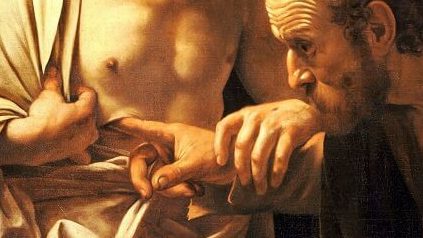
Caravaggio’s take is pretty graphic:

And rightly so. It’s a forensic examination. It’s an autopsy on a living corpse.

What Jesus is doing is crashing the disciples’, Thomas’s notion of the whole nature of reality. He himself is making it as graphic as possible because—

Meat

Jesus is using The Matrix’s most powerful illusion, the solidity of this meat—his meat, Thomas’s meat, my meat, your meat—to crash the whole reality of The Matrix.

But it’s much more than even that.

Luke’s Realization

The last thing Obi-Wan does before his Jedi robe falls empty, remember, is to make sure Luke is watching. He is, as I’ve said, putting on a show:

First, with a little Jedi jujitsu he flips Vader’s big fat bully worldview on its big fat bum. You can’t kill me, he shows Vader. I’m not this meat. This meat isn’t even real.

But more importantly Obi-Wan is showing Luke not what he—Obi-Wan—can do. Vanish—poof! ta-da! Nope, Obi-Wan is showing Luke what he—Luke himself—is. The not-meat.

And indeed in The Last Jedi, at the very end Luke literally realizes that reality—makes real the reality that he’s not this meat—whereupon his Jedi robe wafts empty into the air.

Unrepentant

Astoundingly, there’s another radically different model of reality—not just utterly unrepentant, but totally rebellious—right in the Gospels, staring us all right in the face. Jesus’s Glorified Body. Jedi Jesus. Neo-Jesus. 

He Vanished out of Their Sight

The day Jesus rose from the dead—

Remember Neo at the climactic moment of The Matrix,
when he’s totally flatlined, a couple of bullets in his chest,
and Trinity says to him, “You can’t be dead,” and then
she kisses him, and then, “Now get up,” she commands him,
and totally impossibly, with nothing but his mind
—which is of course and always has been outside The Matrix—
he executes the most inconceivable, the most über of hacks
ever witnessed, and up he rises.

—the day Jesus likewise rose, the Gospel of Luke tells us, Cleopas and another unnamed disciple are on their way to Emmaus, a village outside Jerusalem.

And they talked together of all these things which had happened.

Luke 24:14

Jesus joins them and tags along—

But their eyes were holden that they should not know him.

Luke 24:16

Clearly a Jedi mind-trick. “These are not the droids you’re looking for,” Obi-Wan says to the stormtroopers. And the one stormtrooper says to the other, “These are not the droids we’re looking for,” and the stormtroopers let Luke and Obi-Wan, C3PO and Artoo pass: for their eyes were holden

So Jesus plays dumb and asks, 

What manner of communications are these that ye have one to another, as ye walk, and are sad?

Luke 24:17

Cleopas is dumbfounded.

Art thou only a stranger in Jerusalem, and hast not known the things which are come to pass there in these days?

Luke 24:18

Finally they reach Emmaus, and they ask Jesus to join them for dinner.

And it came to pass, as he sat at meat with them, he took bread, and blessed it, and brake, and gave to them. And their eyes were opened, and they knew him; and

—the Wachowskis, George Lucas couldn’t’ve staged it better—

he vanished out of their sight.

Luke 24:30-31

Jesus dematerializes right before their astonished eyes. Poof.


Tune in next time for...

You no doubt remember the scene in Star Wars: A New Hope in which, after the Millennium Falcon gets caught in the Death Star’s tractor beam and brought aboard, Luke and Han…

Coming 22 October 2021